
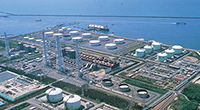
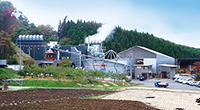
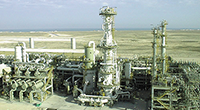
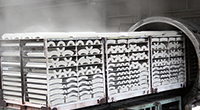






Liquefied natural gas (LNG) and liquefied petroleum gas (LPG), recognized as clean energy sources, liquefy when they are cooled at a cryogenic temperature or when moderate pressure is applied to them. Accordingly, any carelessness in cold insulation work will result not only in an increase in boil-off gas but also in lower transportation efficiency. We have achieved world-class results in a series of cold insulation work related to LNG and LPG, from on-site liquefaction equipment to low-temperature liquefaction carriers and domestic storage facilities, by using our long-cultivated cryogenic cold insulation technology.
LNG Disperse Protection Shield
A shield to prevent LNG spillage from valves or pumps installed within the LNG terminal.
Natural gas offers greater stability in supply capabilities than conventional energies and brings about high energy efficiency in addition to economic efficiency and convenience. It has also been verified that the production of carbon dioxide can be minimized and the impact of environmental pollutants such as SOx and NOx on the environment is extremely low with their overwhelmingly small discharge amounts.
offers total assistance.


Liquefaction plant
For LNG, natural gas mined from underground is liquefied by cooling it to -162°C or applying pressure to it. As a result, the volume of liquefied natural gas becomes one six-hundredth of the gas state which brings about advantages in mass transportation and storage.
Shipment facilities
Gas liquefied by cooling it to a cryogenic temperature is shipped carefully.

LNG/LPG carrier
LNG and LPG are transported by sea to consuming regions by carriers. Tank insulation is important for low-temperature liquefied gas (LNG, LPG) carriers, and our insulation technology minimizes the evaporative (boil-off) loss of liquefied gas.

Receiving facilities
These facilities are used to unload LNG from the landed LNG carrier.

Storage
LNG is stored in tanks in a liquid state. Our thermal insulation technology is used for both aboveground and underground tanks.
Vaporizing facilities
These facilities are used to restore LNG to natural gas by vaporizing it.After adjustment of the heat amount, gas is supplied as city gas or fuel for power generation.

